
PyETK Electronic Transformer Toolkit
0.5.0

Supported Ansys versions:
  • 2025 R2,
  • 2026 R1
Required Product:
  • AEDT
Automatic Electronic Transformer Creation
Free

What's new

Added
  • Log and Settings Open by Default (#211)
  • Browse Removal (#221)
  • User-Defined Materials Support: Users can now add their own materials alongside the shipped material libraries. (#429)
Fixed
  • Core and Conductor Faceting: Faceting now consistently uses the Segmentation Number instead of a combination of angle and segment count. (#201)
  • JSON Frequency Units: Corrected frequency unit handling in the JSON import workflow. (#208)
  • Half-Symmetry U/UI Core Models: Added region and winding support for half-symmetry U-core and UI-core models. (#209)
  • UI Defaults: Updated default user interface settings for a more consistent experience. (#213)
  • Frontend Validation: Added validation checks to improve input verification and error handling. (#239)
  • JSON Loading Issues: Resolved issues affecting current excitation and insulation thickness during JSON import. (#264)
  • JSON Insulation Import: Improved insulation data import reliability. (#302)
  • JSON Export: Corrected handling of None connection keys during JSON export. (#313)
  • Skin Layers and Materials: Fixed skin layer issues and enhanced material class functionality. (#339)
Documentation
  • Contributor Updates: Updated individual contributor acknowledgements. (#196)

App Description

PyETK (Python Electronic Transformer Toolkit) is a PyAEDT-based application for the automated creation, simulation, and analysis of electronic transformers and inductors in Ansys Maxwell. Built as a modern reimplementation of the original Electronic Transformer Toolkit, PyETK provides a backend-driven architecture that transforms structured transformer definitions into ready-to-solve finite element models.

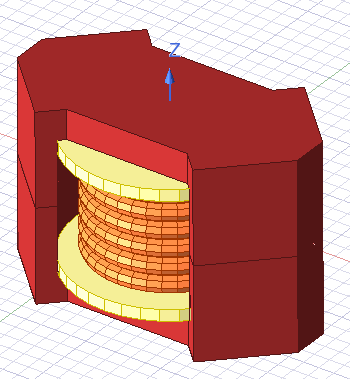
The toolkit automates geometry creation, winding generation, material assignment, matrix connections, and Eddy Current simulation setup, including optional frequency sweep analyses. Support is provided for planar and wound transformer topologies using rectangular or circular conductors, with built-in libraries of commonly used magnetic core geometries and materials. PyETK also models frequency-dependent permeability and Steinmetz core-loss characteristics, enabling accurate evaluation of high-frequency magnetic devices.

By leveraging PyAEDT, PyETK enables use through Python scripting, automated workflows, REST services, and graphical user interfaces, reducing the effort and expertise required to perform high-fidelity electromagnetic simulation.

Key Benefits

Automates transformer and inductor model creation, reducing manual setup effort and engineering time.
Accelerates design iteration by enabling rapid evaluation of multiple design alternatives.
Improves modelling consistency through standardized, repeatable workflows.
Supports both GUI-based and Python-driven operation for engineers with varying levels of simulation expertise.
Enables scalable batch processing and design automation for optimization studies.
Provides accurate high-frequency electromagnetic analysis using Ansys Maxwell solvers.
Integrates easily into existing engineering workflows through APIs, structured input data, and automation frameworks.
Reduces the expertise required to create high-fidelity transformer simulation models while improving productivity and reproducibility.

Use Cases

Generate ready-to-simulate transformer and inductor models directly from analytical design calculations.
Integrate electromagnetic validation into in-house design, sizing, and optimization workflows.
Perform rapid evaluation of alternative core, winding, and material configurations.
Automate design-space exploration and parametric studies using Python-based workflows.
Create frequency-dependent transformer models for downstream circuit and system-level simulation.
Enable batch generation and simulation of multiple transformer variants.
Support third-party software integration through structured data exchange and API access.
Evaluate high-frequency effects, including leakage fields, proximity effects, and core losses, using Maxwell finite element analysis.

Images

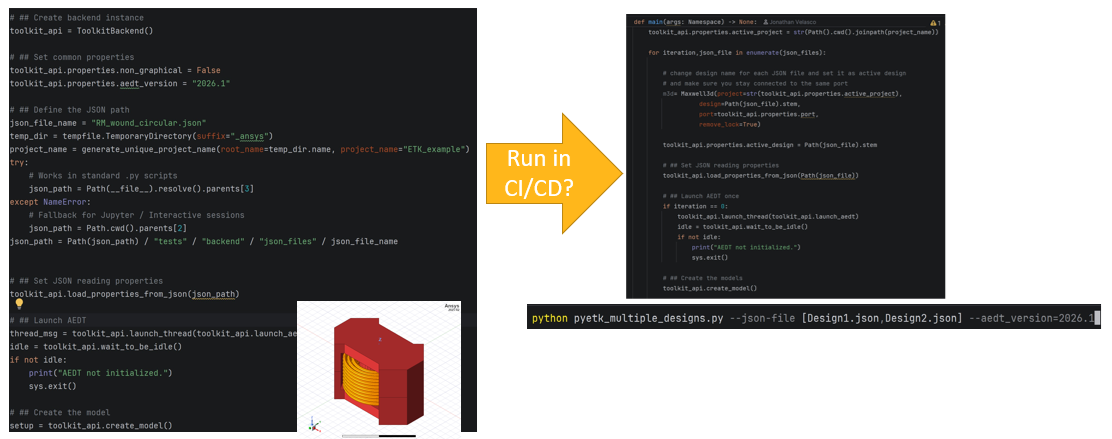
PyETK Backend Screenshot PyETK Backend Screenshot
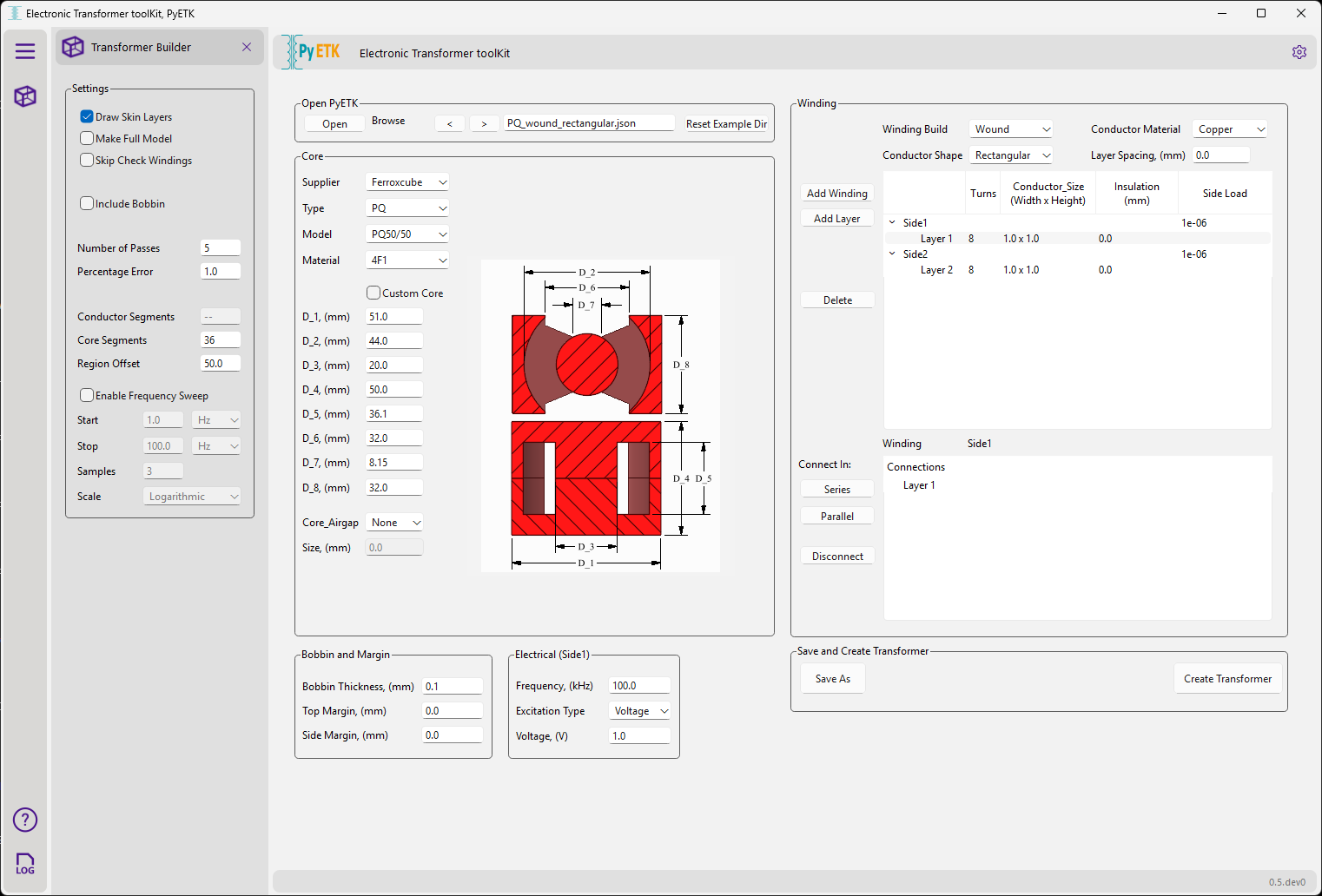
PyETK FrontEnd Screenshot PyETK FrontEnd Screenshot
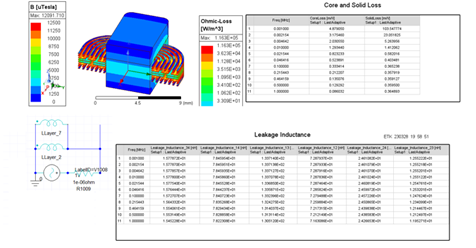
PyETK Results PyETK Results

Latest version

PyETK Electronic Transformer Toolkit 0.5.0
Supported Ansys versions: 2025 R2, 2026 R1
Publisher
Ansys Inc
Support information
Southpointe 2600 Ansys Drive, Cannonsburg, PA USA
724-746-3304

Connect with Ansys