

simulation_framework::core::time::IClock Class Reference
Last update: 19.09.2025Interface for managing and manipulating simulation time. More...
#include <i_clock.h>
Public Member Functions | |
| virtual | ~IClock ()=default |
| Virtual destructor. | |
| virtual void | SetNow (const milliseconds &ms)=0 |
| Sets the current simulation time. | |
| virtual void | SetNow (const Timestamp ×tamp)=0 |
| Sets the current simulation time using a timestamp. | |
| virtual milliseconds | GetNow () const =0 |
| Gets the current simulation time in milliseconds. | |
| virtual Timestamp | GetNowAsTimestamp () const =0 |
| Gets the current simulation time as a timestamp. | |
| virtual void | IncrementBy (const milliseconds &ms)=0 |
| Increments the simulation time by a specified duration. | |
Detailed Description
Interface for managing and manipulating simulation time.
The IClock class provides a generic interface for handling simulation time. It allows setting the current simulation time, retrieving it in different formats, and incrementing time by a specified duration.
This interface is particularly useful in simulations where time needs to be controlled programmatically rather than relying on real-world time progression.
Constructor & Destructor Documentation
◆ ~IClock()
|
virtualdefault |
Virtual destructor.
Ensures proper cleanup of derived classes.
Member Function Documentation
◆ GetNow()
|
pure virtual |
Gets the current simulation time in milliseconds.
This method returns the current simulation time as a duration measured in milliseconds since the epoch (0 milliseconds).
- Returns
- The current simulation time as a
millisecondsobject.
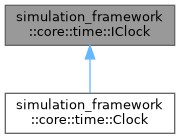
Implemented in simulation_framework::core::time::Clock.
◆ GetNowAsTimestamp()
|
pure virtual |
Gets the current simulation time as a timestamp.
This method returns the current simulation time as a Timestamp object, providing a more precise representation of the current point in time.
- Returns
- The current simulation time as a
Timestampobject.
Implemented in simulation_framework::core::time::Clock.
◆ IncrementBy()
|
pure virtual |
Increments the simulation time by a specified duration.
This method adds the given duration (in milliseconds) to the current simulation time. It is useful for progressing the simulation clock in a controlled manner.
- Parameters
-
ms The duration to add to the current simulation time.
Implemented in simulation_framework::core::time::Clock.
◆ SetNow() [1/2]
|
pure virtual |
Sets the current simulation time.
This method allows setting the simulation's current time to a specific duration from the epoch (0 milliseconds).
- Parameters
-
ms The time to set, represented as milliseconds from the epoch.
Implemented in simulation_framework::core::time::Clock.
◆ SetNow() [2/2]
|
pure virtual |
Sets the current simulation time using a timestamp.
This method sets the simulation's current time to a specific point in time, represented as a Timestamp object.
- Parameters
-
timestamp The point in time to set as the current simulation time.
Implemented in simulation_framework::core::time::Clock.
The documentation for this class was generated from the following file: