

ZOSAPI.Editors.TDE.IToleranceDataEditor Interface Reference
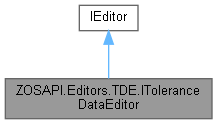
Last update: 17.07.2025This interface defines all properties and methods needed to interact with the Tolerance Data Editor. This interface can be accessed via the IOpticalSystem interface. More...
Public Member Functions | |
| ITDERow | GetOperandAt (int OperandNumber) |
| Gets the data for the specified operand. | |
| ITDERow | InsertNewOperandAt (int OperandNumber) |
| Inserts a new operand at the specified position. | |
| ITDERow | AddOperand () |
| Adds a new operand as the last operand in the system. | |
| bool | RemoveOperandAt (int OperandNumber) |
| Removes the operand at the specified location. | |
| int | RemoveOperandsAt (int OperandNumber, int numOperands) |
| Removes one or more operands at the specified location. | |
| bool | ShowTDE () |
| Shows this editor in the UI. Note that this only has an effect if the IOpticalSystem.Mode is ZOSAPI_Mode.Plugin. | |
| void | HideTDE () |
| Closes this editor in the UI. Note that this only has an effect if the IOpticalSystem.Mode is ZOSAPI_Mode.Plugin. | |
| bool | LoadToleranceFile (string fileName) |
| Loads a tolerance file, replacing the tolerances in the current lens. | |
| void | SaveToleranceFile (string fileName) |
| Saves the current tolerances to a file. | |
| int | CopyOperands (int fromOperandNumber, int NumberOfOperands, int toOperandNumber) |
| Copy and paste the specified number of operands from one location to another. Note that it is okay for the source and destination to overlap. | |
| int | CopyOperandsFrom (IToleranceDataEditor fromEditor, int fromOperandNumber, int NumberOfOperands, int toOperandNumber) |
| Copy and paste the specified number of operands from one location (in the specified system) to another location (in this system). Note that it is okay for the source and destination to overlap. | |
 Public Member Functions inherited from ZOSAPI.Editors.IEditor | |
| IEditorRow | GetRowAt (int pos) |
| Gets the row at the specified index (0 to NumberOfRows-1). | |
| IEditorRow | InsertRowAt (int pos) |
| Inserts a new row at the specified index (0 to NumberOfRows). Note that some editors - such as the Lens Data Editor may not allow inserting new rows before the first row. | |
| IEditorRow | AddRow () |
| Adds a new row at the end of the editor. | |
| bool | DeleteRowAt (int pos) |
| Deletes a row at the specified index (0 to NumberOfRows-1). Note that all editors require at least one row, and some editors may require more than that. | |
| int | DeleteRowsAt (int pos, int numberOfRows) |
| Deletes one or more rows at the specified index (0 to NumberOfRows-1). | |
| int | DeleteAllRows () |
| Deletes all rows from the current editor. | |
| bool | ShowEditor () |
| Shows this editor in the UI. Note that this only has an effect if the IOpticalSystem.Mode is ZOSAPI_Mode.Plugin. | |
| void | HideEditor () |
| Closes this editor in the UI. Note that this only has an effect if the IOpticalSystem.Mode is ZOSAPI_Mode.Plugin. | |
Properties | |
| int | RowToOperandOffset [get] |
| Offset from a row index to operand index (always 1). | |
| int | NumberOfOperands [get] |
| Gets the total number of operands in the current system. | |
| ToleranceColumn | FirstColumn [get] |
| Gets the first available column. | |
| ToleranceColumn | LastColumn [get] |
| Gets the last available column. | |
| INSCToleranceWizard | NSCToleranceWizard [get] |
| The Nonsequential Tolerance Wizard. | |
| ISEQToleranceWizard | SEQToleranceWizard [get] |
| The Sequential Tolerance Wizard. | |
| Properties inherited from ZOSAPI.Editors.IEditor | |
| EditorType | Editor [get] |
| Gets the type of this editor instance. | |
| int | NumberOfRows [get] |
| Gets the number of rows in this editor. Note that this referes to surfaces, objects, or operands depending on editor type. | |
| int | MinColumn [get] |
| The minimum column index that can be used in calls to IEditorRow.GetCellAt for any IEditorRow retrieved from this editor. | |
| int | MaxColumn [get] |
| The maximum column index that can be used in calls to IEditorRow.GetCellAt for any IEditorRow retrieved from this editor. | |
Detailed Description
This interface defines all properties and methods needed to interact with the Tolerance Data Editor. This interface can be accessed via the IOpticalSystem interface.
Member Function Documentation
◆ AddOperand()
| ITDERow ZOSAPI.Editors.TDE.IToleranceDataEditor.AddOperand | ( | ) |
Adds a new operand as the last operand in the system.
- Returns
◆ CopyOperands()
| int ZOSAPI.Editors.TDE.IToleranceDataEditor.CopyOperands | ( | int | fromOperandNumber, |
| int | NumberOfOperands, | ||
| int | toOperandNumber | ||
| ) |
Copy and paste the specified number of operands from one location to another.
Note that it is okay for the source and destination to overlap.
- Parameters
-
fromOperandNumber First operand number to copy (1 to NumberOfOperands). NumberOfOperands The number of operands to copy. toOperandNumber Row to start inserting the operands (1 to NumberOfOperands+1).
- Returns
- The number of operands actually copied.
◆ CopyOperandsFrom()
| int ZOSAPI.Editors.TDE.IToleranceDataEditor.CopyOperandsFrom | ( | IToleranceDataEditor | fromEditor, |
| int | fromOperandNumber, | ||
| int | NumberOfOperands, | ||
| int | toOperandNumber | ||
| ) |
Copy and paste the specified number of operands from one location (in the specified system) to another location (in this system). Note that it is okay for the source and destination to overlap.
- Parameters
-
fromEditor System to copy the operands from. fromOperandNumber First operand number to copy (1 to NumberOfOperands). NumberOfOperands The number of operands to copy. toOperandNumber To operand number (1 to NumberOfOperands+1).
- Returns
- The number of operands actually copied.
◆ GetOperandAt()
| ITDERow ZOSAPI.Editors.TDE.IToleranceDataEditor.GetOperandAt | ( | int | OperandNumber | ) |
Gets the data for the specified operand.
- Parameters
-
OperandNumber The operand number (1 to NumberOfOperands).
- Returns
◆ HideTDE()
| void ZOSAPI.Editors.TDE.IToleranceDataEditor.HideTDE | ( | ) |
Closes this editor in the UI. Note that this only has an effect if the IOpticalSystem.Mode is ZOSAPI_Mode.Plugin.
- Returns
◆ InsertNewOperandAt()
| ITDERow ZOSAPI.Editors.TDE.IToleranceDataEditor.InsertNewOperandAt | ( | int | OperandNumber | ) |
Inserts a new operand at the specified position.
- Parameters
-
OperandNumber The operand number (1 to NumberOfOperands+1).
- Returns
◆ LoadToleranceFile()
| bool ZOSAPI.Editors.TDE.IToleranceDataEditor.LoadToleranceFile | ( | string | fileName | ) |
Loads a tolerance file, replacing the tolerances in the current lens.
- Parameters
-
fileName Name of the input file.
If the file name contains the complete path, such as C:\MYDIR\MYLENS.TOL, then the specified file will be loaded. If the path is left off, then the [data]\Tolerance folder will be used.
- Returns
- Exceptions
-
System.ArgumentException Invalid file name
◆ RemoveOperandAt()
| bool ZOSAPI.Editors.TDE.IToleranceDataEditor.RemoveOperandAt | ( | int | OperandNumber | ) |
Removes the operand at the specified location.
- Parameters
-
OperandNumber The operand number (1 to NumberOfOperands).
- Returns
trueif the operand was successfully remove; otherwise,false.
◆ RemoveOperandsAt()
| int ZOSAPI.Editors.TDE.IToleranceDataEditor.RemoveOperandsAt | ( | int | OperandNumber, |
| int | numOperands | ||
| ) |
Removes one or more operands at the specified location.
- Parameters
-
OperandNumber The first operand number to remove (1 to NumberOfOperands). numOperands The number operands to remove.
- Returns
- The number of operands actually removed.
◆ SaveToleranceFile()
| void ZOSAPI.Editors.TDE.IToleranceDataEditor.SaveToleranceFile | ( | string | fileName | ) |
Saves the current tolerances to a file.
- Parameters
-
fileName Name of the output file.
If the file name contains the complete path, such as C:\MYDIR\MYLENS.TOL, then the specified file will be created. If the path is left off, then the [data]\Tolerance folder will be used.
- Exceptions
-
System.ArgumentException Invalid file name
◆ ShowTDE()
| bool ZOSAPI.Editors.TDE.IToleranceDataEditor.ShowTDE | ( | ) |
Shows this editor in the UI. Note that this only has an effect if the IOpticalSystem.Mode is ZOSAPI_Mode.Plugin.
- Returns
Property Documentation
◆ FirstColumn
|
get |
Gets the first available column.
The first column.
◆ LastColumn
|
get |
Gets the last available column.
The last column.
◆ NSCToleranceWizard
|
get |
The Nonsequential Tolerance Wizard.
- Returns
◆ NumberOfOperands
|
get |
Gets the total number of operands in the current system.
The number of operands.
◆ RowToOperandOffset
|
get |
Offset from a row index to operand index (always 1).
The row to operand offset.
◆ SEQToleranceWizard
|
get |
The Sequential Tolerance Wizard.
Usage (see Example 14 for a full sample)
C#
C++
Matlab
Python
- Returns